Operating plan 1.11.2025-31.10.2026
This operating plan was approved at the club's autumn general meeting on 30.10.2025. This is an unofficial translation. The Finnish version is the official one.
This year's operating period is shorter, because the 2024 autumn general meeting approved an amendment to the rules changing the association's operating period to match the competitive season of the sport, and the new rules were confirmed by the Finnish Patent and Registration Office (PRH) on 22.8.2025. The operating period now ending therefore ran from 1.1.-31.10.2025, and from now on the club's operating period is 1.11.-31.10., in line with the football season.
At the end of October 2025, the following Pelipassi (player licence) registrations were held with Pakkalan Palloseura:
- 712 junior players (born 2008-2021) – 530 (M) / 182 (F)
- 73 adult players (born 1899-2007) – 65 (M) / 8 (F)
- 107 Korttelipassi recreational junior licences (born 2008-2021) – 70 (M) / 37 (F)
- 35 adult recreational players (born 1899-2007) – 10 (M) / 25 (F)
For Pakkalan Palloseura, 2026 is a year of building and of consolidating quality. The club is moving into a more goal-oriented phase, in which a unified coaching approach, a professional coaching culture and a clear player pathway form the foundation of everything we do.
PPS wants to be a club where players, coaches and families feel they belong to a community that supports development, competition and growth – both on and off the pitch.
Current situation in our operating environment
- Growth in player numbers has levelled off but remains stable – Facilities are currently sufficient, and coaching resources have been increased
- Developing sporting activities – Our club's key choice is to be a goal-oriented and competitive development club in the future
- The area is growing and developing (Aviapolis, the new Muura area, Lentola) – We follow developments, keep up to date with changes in the area and aim to gain more members in these areas
- There are many businesses in the area – Developing partnerships and reciprocity, with a special focus on this area in the 2026 season
- Developing fundraising – Opportunities for cooperation, centralised projects, and greater impact and visibility by working together
- The City of Vantaa's sports policy strategy – Grant criteria are changing, new sports venues
- For winter facilities, a solution has been found with private operators – Winter drop-out is still a problem, along with the challenges of local participation and the impact of facilities on the club's competitiveness and finances
- Cooperation with other clubs – We will invest in our existing cooperation agreements
Core objectives for the 2026 season
- We offer high-quality football in Central Vantaa. We are genuinely a club for everyone, open and easy to approach. We want to develop our competitiveness while making sure that everyone stays involved: both goal-oriented players and those who play casually. We work to ensure that there are suitable activities for everyone and that players of different levels can develop on their own pathway with us. Our aim is also to offer a developing and inspiring environment for those aiming for the top. In addition, we are focusing even more strongly on the holistic development of players.
- We will continue the work on basic physical activity that began in 2025. Our aim is still to play a strong part in getting local residents moving. Investing in basic physical activity is an essential part of the club's social responsibility. We want to reach local residents and their children more widely and inspire them to be active through our club's activities. We support children and young people in growing towards an active and healthy lifestyle and strengthen their sense of belonging. We are exploring ways to reach our target groups better and to develop easy-access activities, such as expanding the football school and running clubs before children join regular team activities. These areas still have a lot of growth potential. Our goals are also supported by proven measures, such as cooperation with important stakeholders, for example schools and day-care centres. We want to invest even more in this cooperation in the future.
- In the 2026 season we will focus on people and community. We want to reach a new normal: less constant change and fewer new projects, more clarity, routines and balanced work. After the rebuilding phase, we will focus on a good everyday life in which activities are planned and people-centred. The club's most important resource is its people – staff, coaches, volunteers, players and their families.
- PPS is a competitive and goal-oriented development club in its area, offering all players a high-quality pathway from recreational football towards a higher level. Everyone is kept involved, and everyone has the opportunity to develop and pursue their own best.
- We focus on doing things that support the holistic development of players.
- As a development club, we aim to keep developing and to strengthen an operating culture focused on player development, with a unified, shared operating model in all teams.
- We will launch and establish a two-tier activity model.
- We will start the operational activities of the girls' club cooperation with KoiPS in all target age groups.
Organisation
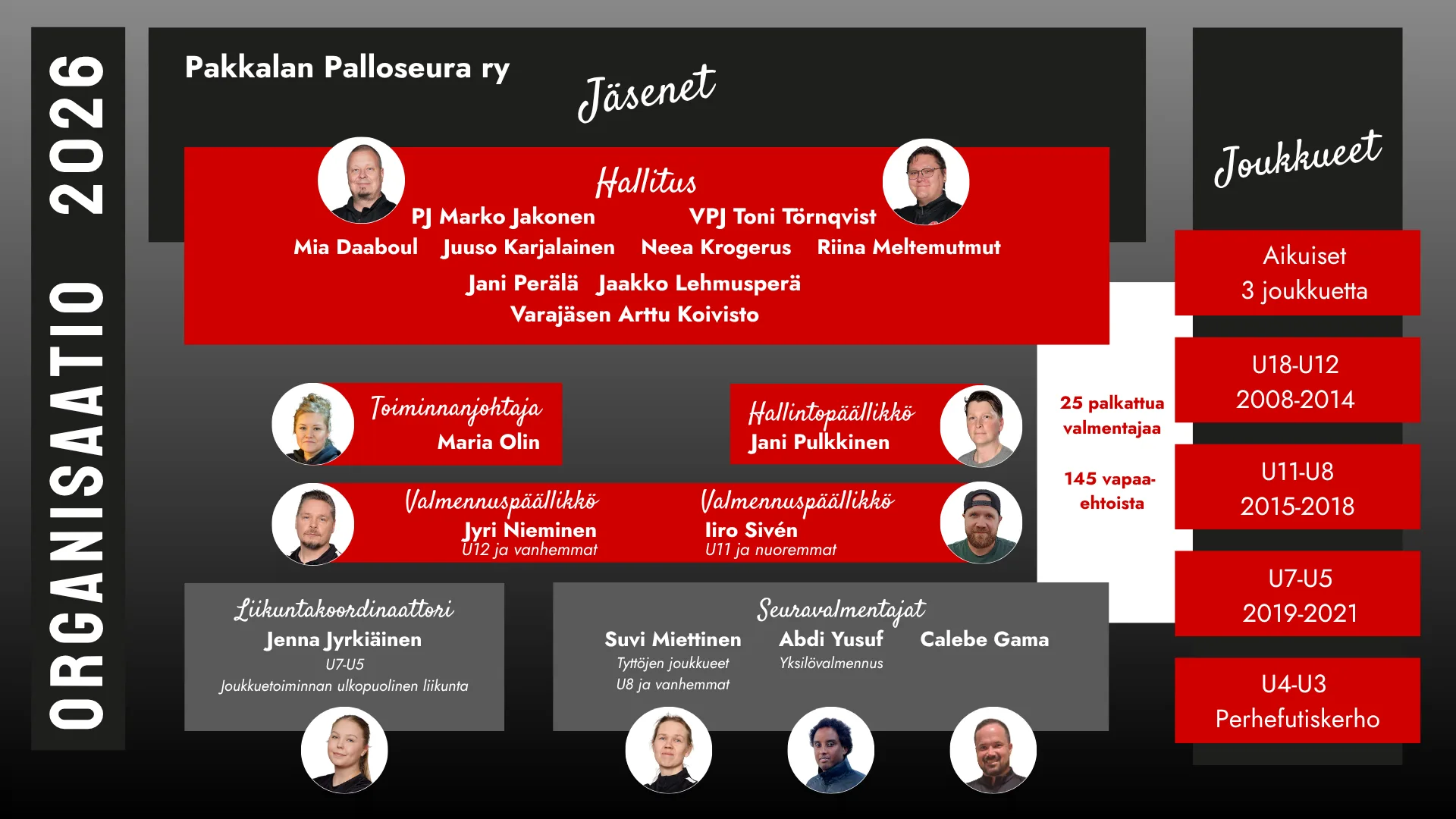
Pakkalan Palloseura organisation 2026: members, board, executive director, administrative manager, two heads of coaching, sports coordinator and club coaches. Teams: adults (3 teams), U18–U12, U11–U8, U7–U5 and U4–U3 Family football club. 25 paid coaches and 145 volunteers.
Key choices
Governance and finances
The club has adopted governance guidelines that further strengthen the principle of good governance. The guidelines serve as internal instructions for the work of the board, staff, team officials and members. The purpose of the guidelines, approved by the board, is to ensure that the club operates openly, responsibly, lawfully and with its members at the centre – in line with the principles of good governance. The guidelines are reviewed at least once during each board term and updated as needed.
At the previous autumn general meeting it was decided to amend the club's rules. Alongside the change to the operating period, the other key reform concerned the composition of the board and extending its term of office to two years. Previously, the entire board was re-elected every year. The new practice promotes stability and continuity, which are key principles of good governance. This change also improves the quality of decision-making and accountability, as board members are involved in following the implementation and effects of their own decisions over a longer period. The previous practice, in which all members stood down at the same time, weakened the continuity of governance and exposed the club to disruptions. Board work is now based on better-planned, gradual renewal, which strengthens the reliability, consistency and long-term focus of the club's governance.
Because of the rule change, the financial year is now exceptionally two months shorter than normal. The financial statements will be approved at the 2026 spring general meeting. The club is financially sound, but the result for 2025 will still show a slight deficit, as forecast in the previous operating plan. At the 2024 autumn general meeting it was decided, among other things, to invest in developing the club's core activities, and new recruitments were planned, again making use of the results of previous financial years. It should also be noted that membership has not grown as expected, various services have generated less income than estimated, and during the year costs such as financial administration rose; the club responded to this by, among other things, changing its financial administration partner.
The cost of living in society has continued to rise, and unfortunately so has the cost of many services and activities the club buys, while at the same time purchasing power has weakened in many of our players' families. We are identifying and applying for targeted grants, especially for basic physical activity and easy-access activities (Urlus Foundation, Helsingestiftelsen).
In May 2025, bookkeeping and financial administration moved to Finaxa, a provider specialising in the financial administration of sports clubs. With the change of financial administration partner, the club now has workable processes and clear financial monitoring and reporting. The costs of financial administration and systems have risen, and we are continuing to make these functions more efficient.
The last teams operating with their own bank account moved to the single-account model in March 2025, and the whole club now follows one clear operating model. The club also has an internal financial control model: the two-approver principle, all receipts archived electronically and visible to three people, a monthly financial review and monitoring by the management team.
Fundraising will continue to be developed. Guidelines will be created for teams, and we aim to concentrate efforts on the most profitable fundraising campaigns and events. Together with a new partner, we will promote digital fundraising and develop fan merchandise, and the club will begin developing the commercial side of its own events under closer club leadership.
There is a lot of potential in business cooperation, but here too we see the same economic challenges as households face. We are investing in reciprocal measures that benefit all parties better.
Budget
The budget is based on the income and costs of the whole club's activities (administration, and the management and coordination of sporting activities). Separate spending plans are drawn up for the teams, and their cost centres are monitored and have their own results. The club's largest sources of income are membership fees, players' annual activity fees and the administration fee. The final result for the financial year is estimated to be a surplus of about 1 970 €, and cumulatively the club will remain positive throughout the year. However, external risk factors must be recognised, such as a possible change in membership numbers or other external variables.
The membership fee remains unchanged at 40€. Membership fees are estimated to bring in 35 500€. There will be a moderate increase in players' club fees. See the fees for 2026 below. The club's activity fees are estimated to bring in 112 700€.
The club is introducing a new per-player fee for teams. The administration fee covers club costs that arise directly from the general activities of the teams (bookkeeping, systems, event costs, events for team officials, coaches' clubs, etc.). The administration fee is 4/6€ per player per month and is invoiced together with the team's monthly activity fee. The total effect on a player's costs is 48€/ 72€ per year. Administration fees are estimated to bring in 49 120€.
Other income comes from, among other things, club services such as camps, specialist coaching and facilities, as well as from support payments from corporate partners. The income from this area in particular needs to grow in the future. The club also applies for grants from the City of Vantaa, although these are a very small share relative to costs, and from other organisations that support our activities, which have traditionally been Helsingestiftelsen and the Urlus Foundation.
The largest expense items under administration are staff costs. Facility costs also include, for sporting activities, the salary costs of the club's full-time staff for duties not invoiced directly to teams/ other cost centres, as well as the salary costs of club services such as camps, basic physical activity and specialist coaching. Their share of the budget is -203 659€. Other administrative costs are estimated at -121 259€.
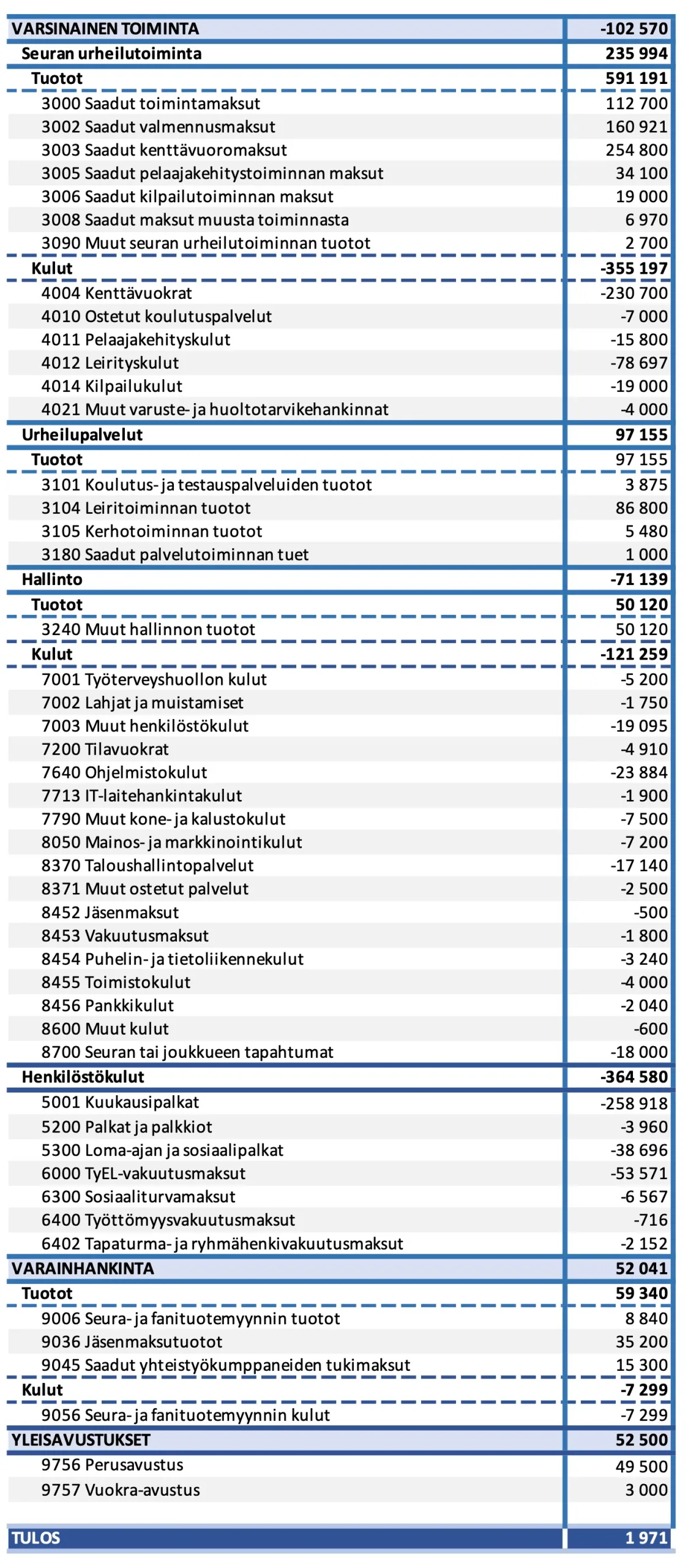
Budget 1.11.2025–31.10.2026 at account level: core activities −102 570 €, fundraising 52 041 €, general grants 52 500 €, result 1 971 €.
Leadership and wellbeing
In the 2026 season, people and their wellbeing are at the heart of the club's activities. The aim is to reach a “new normal” – fewer changes and new projects, more routines, planning and balanced work. After a couple of years of rebuilding, we want to focus on a good everyday life in which activities are clear, predictable and in proportion to our resources. A good everyday life in club activities is built on gratitude, presence, a sense of meaning and attention to people's wellbeing and energy. The club's most important resource is its people – staff, coaches, volunteers and players' families. The wellbeing of everyone involved comes from good leadership, a clear division of responsibilities, the opportunity to have a say, and a sense of safety and community.
The club works on the principle of “together for the common good”. Full-time staff form the backbone of our activities and make everyday life better for everyone involved in the club. The aim is to further develop internal cooperation so that different stakeholders can work together even more effectively and seamlessly. Being systematic and open strengthens trust and community, which we see as the cornerstone of long-term success.
We want to strengthen shared leadership and interaction in the club's operating culture. The board is an important enabler for the club and a support for staff. The club's administrative management supports team managers, and the heads of coaching likewise support coaches. In team organisations, we aim to develop cooperation within each team's own management.
The club has grown into a significant employer with eight full-time employees and 25 part-time coaches. As a responsible employer, the club pays particular attention to managing workload, keeping job responsibilities reasonable, and people's wellbeing at work.
Led by the heads of coaching, a coaches' club will be established to strengthen community and support coaches' development. Coaches are offered regular support, training and mentoring, and every coach has at least two one-to-one conversations a year.
Cooperation with the teams' management groups will be strengthened further. A dedicated forum will be set up for team managers, and team officials will be offered training to develop their skills. In addition, volunteering will be made more systematic by creating clear roles and renewing induction models. The aim is for every volunteer to feel that their work is meaningful and to receive enough support in their role.
The focus of the 2026 season is on leading people and strengthening wellbeing. When the club takes care of its people and their everyday lives, the result is a sustainable, motivated and community-minded environment that supports both sporting and educational goals. Good leadership, openness, planning and caring form the foundation on which we are building the PPS of the future.
Facilities
The club's facilities have improved, especially for winter, but pitch capacity is still limited relative to the growth of our activities. In 2025 some teams played their home matches in places such as Myyrmäki, Hakunila and Rajakylä.
The possibility of building our own pitch has been explored, but for now the project is not being taken forward. Kartanonkoski sports park works well in the summer season, although its capacity is limited. The area is included in the city's upcoming renovation projects. The schedule is still open, but converting the pitch for winter use in the coming years is also being investigated.
New pitch areas are planned for Lentola and Muura, which may ease capacity pressure in the summer season in the coming years and allow the club to grow. We are actively following the progress of new sports venues being built in the area and their impact on our activities. In addition, through club cooperation some teams can train at KoiPS's Sinelli Areena, PuiU's new air dome and Tuusula's Tekova Areena, as well as on its outdoor artificial pitch.
Winter training is split half and half: half takes place in the venues mentioned above, and the other half still takes place in the city's indoor halls. The club aims to play an active part in developing and updating the criteria for allocating sports facilities. Cooperation with the city and other clubs is key to using facilities efficiently and sharing them appropriately.
Sporting activities
In 2026 we will continue and deepen the direction set out in the 2025 plan, but with clearer goals for each area. Sporting activities have been developed with an open mind, by experimenting and exploring. In the 2025 season we have clarified the club's sporting profile and long-term goals and chosen three main themes on which development will focus.
- The first theme is adopting the profile of a competitive and goal-oriented development club. For the 2026 season we are publishing a new coaching approach, which will be introduced systematically in all teams. The aim is a clear playing identity and a unified “PPS way of doing things”: teams' training plans follow the coaching approach, and coaches use a shared bank of drills.
- The second theme is introducing a two-tier activity model that combines a broad base of recreational players with the opportunity for goal-oriented competitive football. This makes both recreational and competitive play possible within the same club, without the two being seen as opposites. The model will be introduced in 2026 in some teams (girls U14 and boys U18–U11) and, if player numbers allow, extended to younger age groups in 2027.
- The third theme is strengthening the girls' club cooperation with KoiPS. The aim is to build a unified and competitive player pathway that gives girls equal opportunities to develop in football. The cooperation supports diverse player pathways and makes it possible to play on your own terms – whether the goal is to compete or to play with friends.
Communications and marketing
In recent years PPS has grown and developed significantly as a sports club. In people's minds, we have moved from being a small neighbourhood club towards a strong, attractive and respected organisation in Vantaa. The quality of the club's activities, its sense of community and its visibility have improved, and we have succeeded in creating a positive and trustworthy brand that attracts new players, coaches and partners.
The club's stronger position can be seen in player numbers, coaching expertise and a growing sense of community. However, we want to keep developing in a long-term and responsible way: growth is not only about numbers but, above all, about quality. The best marketing is satisfied members – players, coaches, volunteers and families who are proud of their club. In 2026 we want to raise this team spirit and strengthen the feeling that PPS is a community where everyone belongs and whose work can be genuinely valued.
Developing the club's internal and external communications is a key part of PPS's future development. The aim is to increase visibility and to make sure that the club's strategy, values and policies are visible in everyday activities.
We are making our website more informative and our communications more multilingual so that we can better serve our multicultural membership. Announcements and important instructions will be published in several languages.
Our social media visibility and reach have grown, and this development will be supported in the future through cooperation with a service provider. The aim is to produce timely, high-quality content that highlights the club's values, activities and the people behind them. Teams' own social media activity is an important part of the club's communications and visibility. In the future, teams will be supported more actively in creating content by providing ready-made tools, guidelines and a shared visual identity.
Stakeholder relations
PPS aims to be an actively networked and versatile sports club that, alongside football, works closely with the City of Vantaa, educational institutions, businesses, and other clubs and sports in the area. The aim is to build a community that is attractive to players and partners alike.
City of Vantaa
The club wants to increase dialogue with the city's various departments. Discussions focus in particular on developing facilities, the allocation of sports facility slots, and the future of sports venue infrastructure in the Aviapolis area. Cooperation with the City of Vantaa's sports services and schools supports the club's goal of promoting an active lifestyle among children and young people.
PPS is also taking part in the City of Vantaa's school team project, which develops easy-access after-school sports activities in cooperation with schools and sports clubs. The aim of the project is to increase children's everyday physical activity and make it easier to take part in club activities. School team activities started in autumn 2025 at Veromäki school and ISV. PPS is responsible for delivering the football activities and acts as a partner club in the city's project.
Schools and day-care centres
PPS continues its cooperation with schools and day-care centres in the area. Taster sessions are offered regularly, and in the winter season activities are expanded with visits to day-care centres.
The Avia Cup event, which began in 2025, continues: in spring there is a tournament for day-care centres at Kartanonkoski, and in autumn a tournament for primary schools (years 1–2), to which schools such as Kartanonkoski, Veromäki, Tammisto, Ylästö and ISV are invited.
Club cooperation
PPS is developing cooperation with other football clubs, such as KoiPS, PuiU and TuPS, especially on facilities and sharing coaching expertise.
Together with our partner clubs I-HK, KoPSe, KoiPS and TiPS, we will continue the annual Starttiliiga (starter league), which offers easy-access match events for beginner age groups and supports children's first experiences of football.
Business cooperation and partnerships
Aviapolis is a fast-growing business area that offers significant opportunities for developing the club's stakeholder relations. PPS is investing in creating new business partnerships and strengthening existing relationships. Partnerships are built for the long term and on a reciprocal basis, with the aim of creating added value for all parties. Working with the club supports companies' corporate social responsibility by promoting local physical activity and wellbeing among children and young people.
PPS also aims to offer its members concrete benefits through partners, such as discounts, events and services, which strengthen the member experience and the club's sense of community.